
Your Witchy Mother
You bring the mess. I make the spell. You work the magic.
How to Do a Morning Mirror Blessing (Ritual for Self-Worth)
Stand in front of a mirror. Look at yourself.
Not to check your hair. Not to make sure your mascara hasn't migrated. Just look ... and stay.
If you made it past two seconds before glancing away, you're ahead of most people I work with.
That flinch, that quick redirect away from your own eyes, is not modesty. It's not humility. It's not some quirk of your personality. That is what shame feels like in the body. And if you came up in a religious environment where vanity was considered a sin, where humility meant making yourself invisible, where spending too much time on yourself was spiritually suspect your nervous system learned, early and efficiently, that your own reflection was a threat.
This post is about undoing that. One morning ritual at a time.
No time to read? 👇🏻
The Mirror Was Never the Problem
In folk magic traditions that predate modern religious frameworks by centuries, the mirror is not a symbol of vanity. It's a symbol of truth. Of witness. Of the clear reflection of what is actually there, as opposed to what we're performing or pretending.
Mirror magic has appeared across cultures — European folk traditions, African diasporic practices, Indigenous ceremony — not as tools for self-admiration, but as tools for clarity. For seeing through illusion. For truth-telling in the most literal sense.
What we were handed in high-control religious systems was a specific and effective inversion of that: the mirror became associated with sin. With self-absorption. With the dangerous territory of thinking too highly of yourself. And that association got layered into our bodies so early that most of us don't even question it — we just feel vaguely guilty for lingering in front of one.
The morning mirror blessing I'm teaching you in this post is a reclamation of the older tradition. It says: your reflection is sacred. Witnessing yourself is not vain. It's necessary. And you have always had the authority to do it.
If the conditioning around pride and self-celebration is still fresh for you, read last week's post: How Religion Trains Women to Disappear (And How to Come Back). This ritual is the practical follow-through to that deconditioning work.
What Anointing Is (Outside the Church's Definition)
If you came from a church background, the word 'anointing' probably carries a lot of weight. In most religious contexts, it was something done to you, by someone with more spiritual authority — a pastor, a priest, an elder. You were the recipient. Someone else conferred the blessing.
That's one lineage. It's not the only one.
In folk practice — in the kitchen witch tradition, in everyday magic that women have carried in their homes for generations — anointing is an act of self-consecration. You choose an oil. You choose your intention. You apply it to your own body as a physical declaration: this is holy ground. I am treating it accordingly.
You do not need permission for that. You never needed permission for that.
And here's what I find endlessly interesting: most women who came from religious backgrounds had no problem accepting that a man at the front of a room could touch their foreheads with oil and call them blessed. But the idea of doing it themselves, for themselves, feels almost transgressive.
That asymmetry is the thing worth examining.
Ready to see where else that pattern shows up? Take the free quiz: What's Your Obedience Contract Costing You?
The Morning Mirror Blessing: Full Practice
This takes five minutes. Do it before your phone, before your email, before you perform yourself for anyone else's benefit.
What You Need:
A mirror — any size. A small hand mirror works perfectly.
An oil — coconut oil, olive oil, almond oil. Rose oil if you have it. Whatever you have.
One candle, if you want it. Not required, but it signals to your body that this is intentional space.
Five minutes of privacy.
Step 1: Create the space.
Light the candle if you're using one. Take one slow breath. Put your phone face down or in another room. You are entering intentional space — this is categorically different from checking your reflection in passing.
Step 2: Look and stay.
Stand or sit in front of your mirror. Look at yourself — not checking, not criticizing, not running the inventory of what needs to be fixed. Just looking. Stay for five seconds. If the urge to look away comes, notice it, and stay anyway. The urge itself is information.
Step 3: Anoint your forehead.
Put a small drop of oil on your fingertips. Touch your forehead — right at the third eye, the center of your brow. As you do it, say out loud: 'This mind is holy. What it knows is true.'
Step 4: Anoint your heart.
Put your oiled hand over your heart — sternum, center of your chest. Say: 'This body is holy. What it feels is real.'
Step 5: Witness yourself.
Look yourself in the eyes again. Say your own name. Just your name. Then say: 'I witness you. I see you. You are enough.'
That's the whole practice. Five minutes. Do it every day for seven days and notice what shifts — not just in your thinking, but in your body. In how you hold yourself walking into a room. In what happens when someone looks at you a half second longer than expected.
What Comes Up When You Try It (And What to Do)
I want to be honest with you: the first time most women try this practice, something unexpected happens.
Sometimes it's resistance — a part of you that pushes back hard against saying those words to yourself. It feels stupid. Embarrassing. Overdone. That resistance is not evidence that the ritual isn't working. That resistance is the conditioning meeting its edge.
Sometimes it's emotion. Out-of-nowhere, have-to-sit-down emotion. Women who haven't cried in years find themselves weeping in front of a bathroom mirror because someone — even if that someone is themselves — is finally staying long enough to actually witness them.
Sometimes it's numbness. Nothing. Which is its own information — a body that has shut down its capacity to receive care because it learned care came with a cost.
Whatever comes up, stay with it. Don't skip the eye contact. Don't rush the words. Let them be awkward and imperfect and real.
For more on why the body patterns around receiving care and praise run so deep, read: Why You Can't Receive Help Without Feeling Guilty
You Cannot Be Sovereign in the World If You Can't Stay in the Room With Yourself
Here's what this practice is actually building:
The capacity to be witnessed. To stay still while something looks at you — even when that something is your own reflection — and not flinch away, not disappear, not immediately redirect.
For women who came from high-control systems, being truly seen was often unsafe. You were seen in order to be assessed, corrected, or found lacking. So your body developed a protective pattern: stay moving, stay useful, stay busy, never hold still long enough to be examined.
The mirror practice interrupts that. Every morning. In small, repeatable doses. It re-patterns the equation: witness doesn't have to mean threat. Being seen doesn't have to end in correction. You can be looked at — fully, without apology — and be safe.
Five minutes a day is not self-absorption. It's the thing that makes everything else possible. It's maintenance. It's refilling the well. It's treating yourself with the same basic regard you'd extend to anyone you love.
If this practice is cracking something open that's bigger than a seven-day ritual can hold — something that keeps returning, keeps showing up in the same patterns, the same flinches, the same rooms — that's when a Clarity Session becomes the right next step. It's a 60-minute deep dive into what your field is actually doing and what's underneath the pattern. The link is below.
Your reflection is not vanity. Your reflection is holy ground. And it has been waiting for you to stop apologizing for looking at it.

Everything your mother never taught you—without the guilt
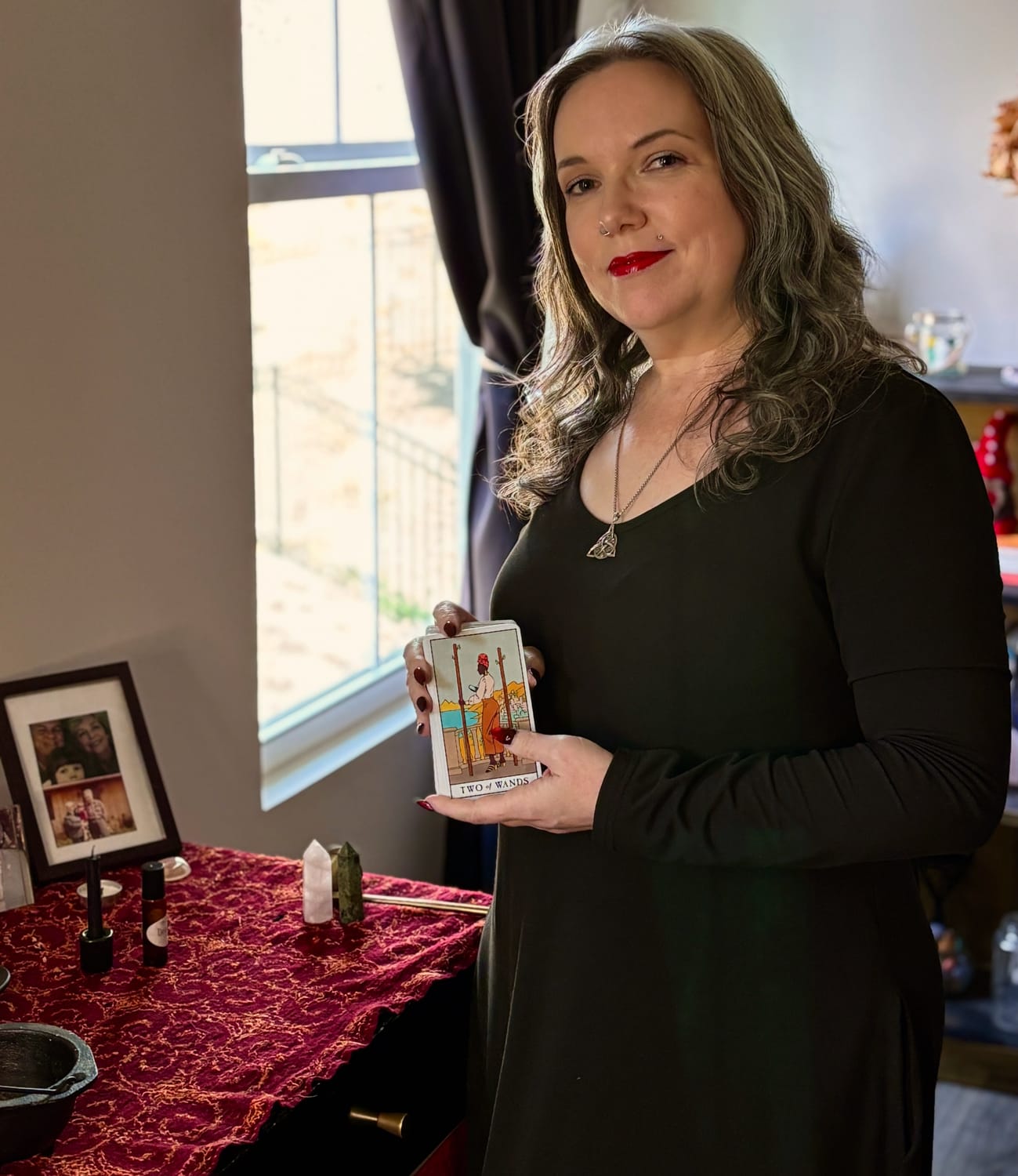
I help women who left control-based systems remember their own power and live it daily. My work is grounded in sovereignty, practical magic, and truth-telling you can feel in your body. I’m the witchy mother who will pour tea, light the candle, and hand you the match.
Join My Mailing List
Thanks for stopping by, witch.
May your magic be loud, your rituals hold true, and your field be steady.




⚡ Built with Systeme.io | Fueled by feminine rage, mushroom coffee, and moonlight.