
Your Witchy Mother
Everything your mother never taught you...without the guilt.
Voice Magic: How to Reclaim Your Voice After Religious Conditioning
Your voice goes up at the end of sentences that aren't questions. That's not a speech pattern. That's what happened to your certainty when certainty was dangerous.
Glamour magic gets misunderstood constantly. People think it's about beauty — how you look, how you dress, the surface presentation. But in the older folk magic tradition, glamour was about the field you project. Your presence. The information your body sends into a room before anyone has consciously processed it. And one of the most powerful components of that field, one of the most frequently damaged, is your voice.
If you grew up in a high-control religious system, your voice was one of the first things they got to. Not just what you were allowed to say. How you were allowed to say it.
Watch the Deep Dive
Listen in the Dark
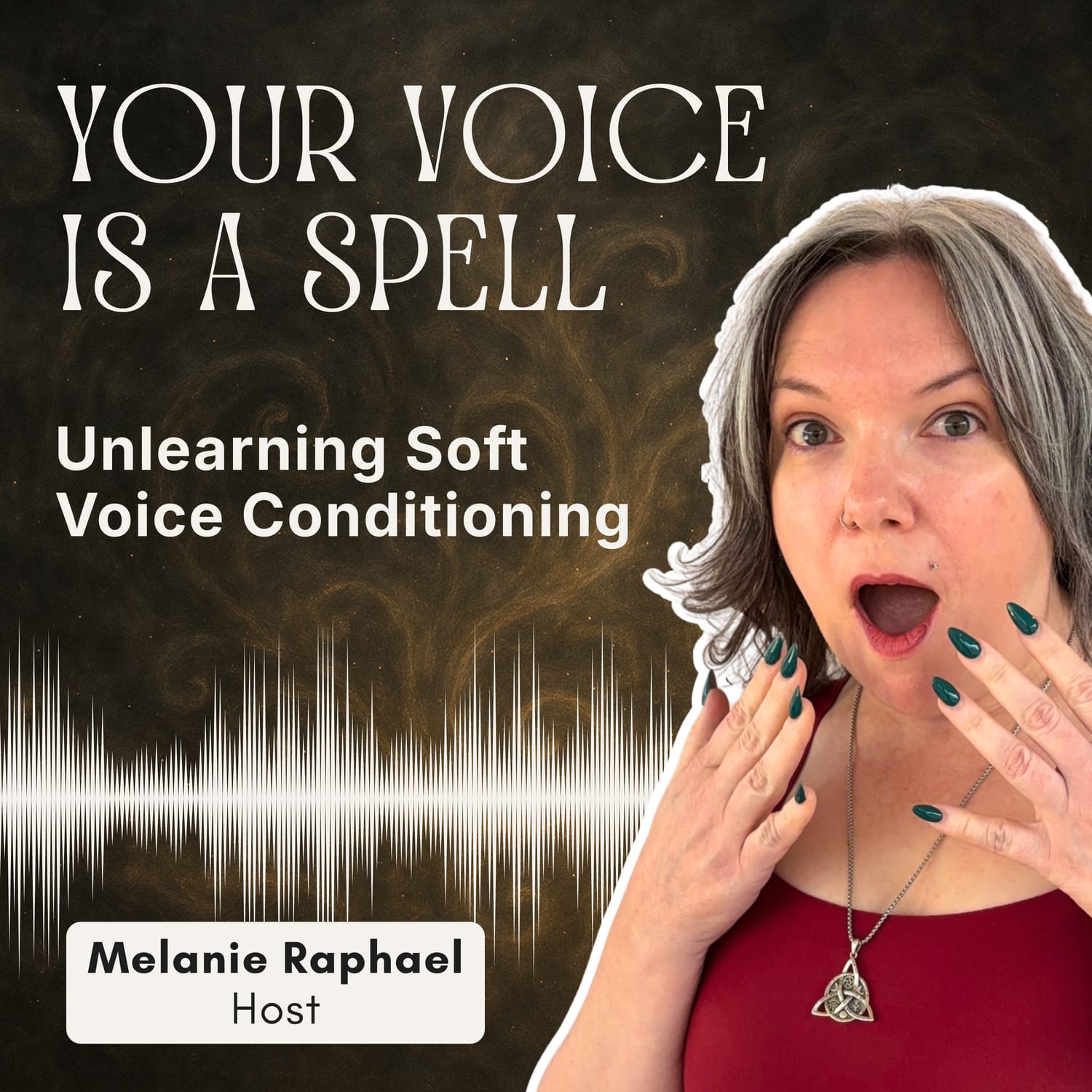
What Soft Voice Conditioning Actually Is
Or, if you're just finding me the Sinner's Grimoire is a free collection of five spells for sovereignty, glamour, money, protection, and receiving. It's the first step.
Every high-control religious system in history has had specific rules about women's voices.
The volume. The tone. The level of certainty you were permitted to project. Women in these systems learn — explicitly through correction and implicitly through watching who gets rewarded — that a soft voice is a holy voice. That speaking with conviction sounds like pride. That taking up sonic space is aggression. That ending your statements with a slight rise — a built-in deferral, a question mark that says correct me if I'm wrong — is humility.
It is not humility. It's a survival strategy that your nervous system learned so thoroughly it started running on its own.
Upspeak — the pattern of ending declarative statements with rising inflection, as though everything you say is a question awaiting approval — is statistically far more common in women, and specifically in women who grew up in environments where certainty invited correction. The same conditioning that taught you to wait for permission before trusting yourself also taught your voice to wait for permission before landing.
Your nervous system learned: a definitive voice invites conflict. A soft voice stays safe.
And so your voice learned to apologize before it finished speaking.
What It Sounds Like From the Inside
Upspeak sounds like ending a statement with "...right?" or "...does that make sense?" when you don't actually need confirmation. It sounds like "I don't know if this is helpful, but..." before something that is clearly helpful. It sounds like "Sorry, can I just say something?" before saying something that required no apology whatsoever.
It sounds like trailing off mid-sentence because you felt the energy in the room shift and decided it was safer to abandon what you were saying than to finish it.
And the one that gets me every time: it sounds like ending your own name with a question mark. Like introducing yourself and going up on the last syllable. Like the most basic fact of your identity is still something you're checking to see if it's okay to claim.
The conditioning that produced this runs deep because it was installed early — in classrooms, at dinner tables, in church pews. Be sweet. Lower your voice. Don't argue. Let him finish. Good girls don't make it a big deal.
Every one of those corrections was a lesson in where your voice was allowed to live. And your body took notes that it is still running from.
Voice as Magical Instrument
In folk magic and old occult tradition, the spoken word has always been understood as one of the most potent tools available — not because of mysticism, but because of physics.
Sound is vibration. Your voice creates literal waves in the air that move through space and land in the bodies of everyone around you. When you speak with conviction, people feel it before they've consciously processed it. When you speak with apology in your tone — that slight softening, that upward drift at the end — they feel that too. And they respond to it, often in ways neither of you is aware of.
The folk practitioners who preserved voice magic — the charm singers, the blessing speakers, the wise women who used spoken word as active spellwork — understood this. How you say something changes what it does in the world just as much as what you say. The words spoken with intention were wards. Declarations. Instruments of real effect.
Your voice was shaped into a question because a woman who speaks with certainty is harder to manage. A woman whose voice ends in a question is perpetually asking for permission she doesn't need.
Reclaiming your voice is not a confidence-building exercise. It's the same work as reclaiming any other part of yourself that a system decided was too much — methodical, repeated, and body-based.
The Red Lipstick Moment
I want to tell you about glamour magic in practice, because this is where it clicks.
I grew up where makeup was vanity and vanity was sin. Pride goes before the fall. Stay small, quiet, grateful — make yourself easy to love. Then marriage, where that message got a megaphone. You're not that great. You're lucky to have me. No one else would tolerate you. When the church teaches you humility and a partner teaches you worthlessness, the line between them disappears. And your voice goes quieter and quieter until you barely recognize it as yours.
Now I can be barefaced, hair a mess, wearing whatever. But the moment red lipstick goes on, something in my body activates. Not a performance. Not a mask. A signal. My nervous system receives it and files: present. taking up space. speak accordingly.
That's glamour magic. That's the whole thing — a somatic anchor, a physical cue that tells your body which version of you is showing up today. And your voice is the same kind of tool. You can use it deliberately. You can practice sending the signal before you need to be in the room. You can recalibrate it with repetition until your body starts to recognize the feeling of speaking from your own center of gravity rather than from the edges of other people's comfort.
The Vocal Ward Practice
This is a five-minute daily practice. Do it before anything that asks you to be seen — a meeting, a hard conversation, a phone call you've been putting off. Do it in private. This is not for an audience. This is for your nervous system.
What you need: A private space. Five minutes. Optional: something physical that feels like yours — a stone, a piece of jewelry, a candle lit nearby.
Ground first. Feet flat. Shoulders down. Two or three slow breaths into your sternum, not your chest. Feel your body take up space.
Speak from your chest, not your throat. Most people shaped by compliance conditioning speak from high in the throat — it's quieter, more controlled, more easily modulated downward when someone needs you smaller. Put your hand on your sternum. Breathe into it. That's where your voice lives when it's actually yours.
Speak three declarations out loud. Not affirmations — things you're hoping to believe. Declarations — things you're stating as fact, in your own voice, on your own authority.
Start with your name. Not as a question. As a statement. "My name is [your name]." All the way to the period. No uptick. No apology in the tone. Say it until it feels flat and certain rather than uncertain and offered-up.
Then: "I know what I know." Then: "My voice carries weight."
Say each one slowly. All the way to the end. Resist the pull to soften the final syllable.
Add your own. What does your voice need to claim today? Say it as a fact — not a wish, not a maybe. A thing that is true.
Sit in it. Don't immediately move on. Let the words land in your body. Notice where you wanted to soften and didn't. That gap between the impulse to defer and the choice to stay — that's the practice. That's where your voice is coming back.
You can also use red lipstick, or anything else that functions as a somatic anchor for your glamour field, as part of this ritual — apply it before or after the declarations, let the physical act reinforce the vocal one. The layering of glamour tools is intentional magic, not indulgence.
What Shifts When Your Voice Does
When you stop carrying the apology in your tone, people notice. Not always consciously — but the conversation changes. The negotiations change. The people who were relying on the question mark in your voice — who needed that deferral to feel comfortable — will sometimes push back. Will call you cold, or difficult, or aggressive.
Pay attention to who that is. It's useful information about whose comfort your soft voice was protecting.
Your voice was never supposed to be comfortable for everyone. It was supposed to be true. Glamour magic has always been about this — not surface beauty but the field you project, the energetic information you send into a room. When your voice is genuinely yours — clear, grounded, speaking all the way to the period — it changes the transaction.
You don't have to be loud. You don't have to perform certainty you haven't built yet. You just have to stop ending your truths in questions.
Say what you know. Out loud. All the way to the end.
The Witch in the Pew is a live monthly ritual workshop for women doing reclamation work in real time — with salt, fire, and spoken word.
Just finding me? The Sinner's Grimoire is free — five spells for sovereignty, glamour, money, protection, and receiving.


Everything your mother never taught you—without the guilt
I help women who left control-based systems remember their own power and live it daily. My work is grounded in sovereignty, practical magic, and truth-telling you can feel in your body. I’m the witchy mother who will pour tea, light the candle, and hand you the match.
Join My Mailing List
Thanks for stopping by, witch.
May your magic be loud, your rituals hold true, and your field be steady.
Made with love (and just a little chaos) by Melanie Raphael.




⚡ Built with Systeme.io | Fueled by rebellion, mushroom coffee, and moonlight.